
Current affairs
Will a fundamental change happen in Iran from the Zagros Mountains?
On the 28th of 2026, the United States announced the killing of Ali Khamenei, the Supreme Leader of the Islamic Republic of Iran. What is worth discussing now, after Khamenei’s death, is who will replace him, or whether we should expect the end of the Islamic system of Velayat-e Faqih (Guardianship of the Islamic Jurist).
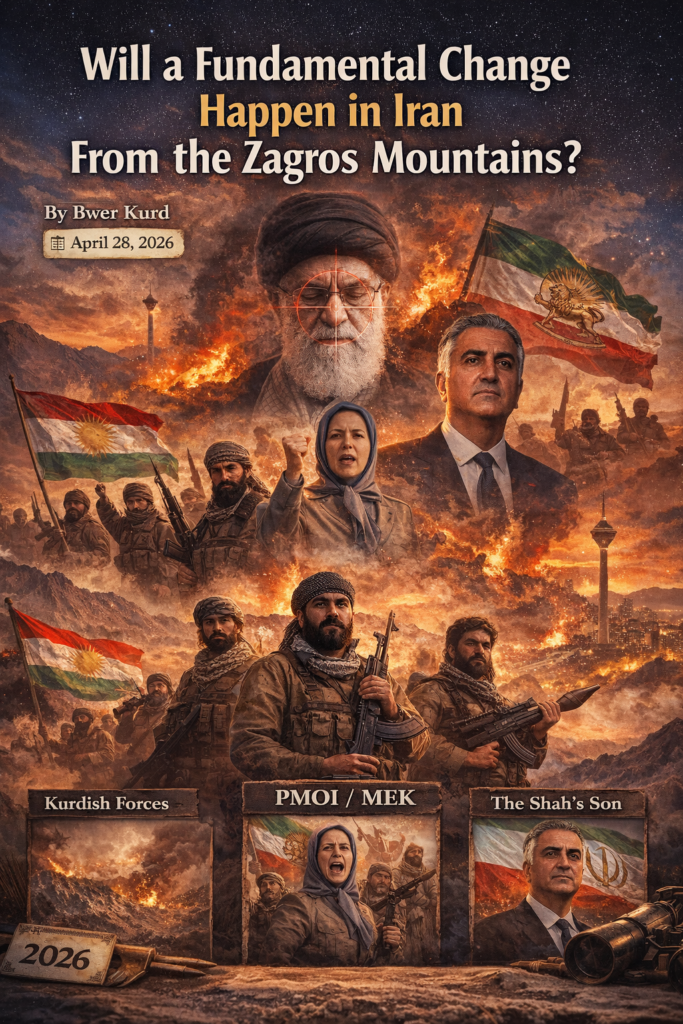
On the 28th of 2026, the United States announced the killing of Ali Khamenei, the Supreme Leader of the Islamic Republic of Iran. What is worth discussing now, after Khamenei’s death, is who will replace him, or whether we should expect the end of the Islamic system of Velayat-e Faqih (Guardianship of the Islamic Jurist).
It is noteworthy that Khamenei had held the position of Supreme Leader since 1989.
So far, the United States and Israel have not decided to send ground troops into Iranian territory, but PJAK has announced that the possibility of a military and ground attack exists.
Iran’s Options
After the attacks carried out against the Islamic Republic of Iran, which are still ongoing, the question arises: who will replace the Islamic Republic? The options are not clear.
First Option
One potential force in the field could be the Kurds. In reality, Kurdish opposition forces have made preparations. In particular, on February 22 — six days before the first U.S.-Israeli missile strike on Tehran — five Kurdish parties achieved something that the rest of the Iranian opposition had failed to accomplish over the past 40 years: they formed an alliance under the name “Alliance of Political Forces of Iranian Kurdistan.”
Although the Iranian Islamic regime carried out drone attacks on refugee camps in Eastern Kurdistan and several Peshmerga bases, wounding several people, Kurdish forces possess military power and appear more prepared for armed action than others.
However, they are primarily focused on Kurdish regions in eastern Iran and do not wish to expand operations into other parts of Iran. This stems from recent Kurdish experience in Syria, when Kurdish forces cleared Arab areas of داعش (ISIS), and later the United States allowed attacks against the Kurds in those Arab regions after making alternative arrangements.
Second Option
People’s Mujahedin Organization of Iran (PMOI / MEK)
This organization was founded in 1965 and initially opposed the Shah of Iran. After Khomeini came to power, especially from 1981 onward, the Mujahedin began organized opposition against the Islamic Republic.
They present themselves as a secular force and possess a semi-military structure. Today, Maryam Rajavi leads the organization.
In recent days, Maryam Rajavi released a six-point statement. Most importantly, it rejects the doctrine of Velayat-e Faqih and calls for a republican system. The statement also accepts Kurdish self-administration.
However, this group does not have broad grassroots support inside Iran, nor does it enjoy strong international backing, particularly from the United States, Europe, or Israel.
Third Option
The Shah’s Son
In 1979, when Khomeini returned and the Islamic regime came to power, the Shah fled Iran and later died in exile. His eldest son had already gone to the United States for education one year before the fall of his father’s rule, when he was 17 years old.
Although it is estimated that he may have many supporters, it is doubtful that he has strong backing inside the country. Most of his supporters appear to be in Europe and the United States.
In general, non-Persian nationalities believe that the Shah brought only repression and destruction to them, especially the Kurds, and they strongly oppose the return of a monarchy to Iran.
Reza is known as a nationalist figure who believes in Persian dominance.
At the same time, Donald Trump is reportedly uncertain whether he would be a suitable person to assume power in Iran.
On the other hand, after the Kurdish alliance statement was published, Reza Shah declared his opposition to that alliance and stated that if he became the country’s leader, he would be prepared to mobilize forces against the Kurds and once again push Kurdish political parties out of Eastern Kurdistan.